Categories
Microsoft365 Windows 11

Summary Post: How Windows Device Check-in Works With Intune

I don’t blog about Intune nearly as much as I used to, now that I no longer work for Microsoft and have a greater focus on the Apple ecosystem (which, to be fair, Intune still plays a pretty significant role with iPad/iPhone management).

However, I like to keep across what is happening in this space and I saw a great tweet earlier this week that touched on one of the age old complaints about Intune – the perceived slowness of policy synchronisation (especially compared to other MDM such as Jamf). The tweet came from Rudy Ooms who describes himself as:

Content Creator at Patch My PC | Reverse engineering Intune and Windows internals. Sharing what actually happens under the hood.

Back in 2019 I shared a similar blog post from Oliver Kieselbach entitled New To Intune As An MDM? Read This Blog Post First! – SamuelMcNeill.com (which is still a good read), where Oliver dived into how policy syncs work. In this newer post from Rudy, he tackles similar ground but with a view 6yrs on (wow, time flies!) and as always, I encourage you to read the original post in full:

Intune Sync and Policy Delivery: Debunking the 8 Hour Myth

Rudy does have a video overview of this topic if you’re more into listening and watching than reading:

I’ll share a few highlights from the post that are pertinent in my view, starting with:

Microsoft has documented this first enrollment sync behavior: during the Intune/MDM enrollment, devices check in more frequently to PULL down configuration profiles, certificates, and policies.

  • Every 3 minutes for the first 15 minutes
  • Then every 15 minutes for the next 2 hours
  • And only after that, it shifts to the ~8-hour cycle

Those first two bullet points are generally pretty well understood and most IT Pros will have seen this frequent sync and update during the first OOBE workflow (Out Of Box Experience).

Rudy correctly focuses on “Change Based Check-ins” with Intune and has even created a great diagram to help explain that:

To expand on that, he talks about the role of the Windows Notification Service (WNS) which functions in a similar fashion to Apple’s own Push Notification Service (APN – Configure devices to work with APNs – Apple Support (NZ)). As explained by Rudy:

That push message travels over the Windows Notification Service (WNS) and tells the device to check in. These are the triggers that make Intune notify devices:

  1. Changing targeting (adding or removing a device or user group)
  2. Editing a payload (changing/adding a new Intune policy or updating app assignment)
  3. Entra group membership changes
  4. Store app version updates released by the vendor

In practice, the first policy change is usually pushed down within a few minutes. From there, Intune enforces a quiet period/throttle (roughly 30 minutes per device) before sending another push. So, while it’s not instant like a remote wipe (which must always be immediate), it’s still far faster than waiting for the full 8-hour maintenance cycle. Let me zoom in on the push message itself a bit more.

The blog includes some interesting testing data showing that the WNS is somewhat of a ‘black box’ in terms of how it operates and where buffers can come into play between a push of a policy change and execution on the device (again, read the full blog on Rudy’s site).

But What About Throttling, You Say?

Something that many frustrated IT Admins have suspected and/or complained about is the preception Microsoft throttles Intune changes to reduce load (either for the Azure cloud or the endpoint). Rudy’s post goes into this in some detail, explaining how the first changes are almost immediate and then subsequent rapid changes are bundled together and throttled:

  • Change #1 → WNS push almost immediate
  • Change #2 and #3 (<30 min later) → bundled, resolved when device responds to the same notification
  • Change #4 (>30 min later) → new WNS push delivered

Whilst this may make a lot of sense for Microsoft, for IT Admins that are perhaps making rapid changes to configurations it can be a source of intense frustration. Of course, in a perfect world IT Admins are cool, calm and collected at all times and make all of their policy configuration changes with a single update. However, that rarely matches the often frenetic pace which busy IT Admins are required to work at and knowing that changes are being bundled and throttled is often a suboptimal experience.

It does sound like there is some work being done by Microsoft to redesign this with something called “Fast Lane” that is broken down in the blog – check it out.

Final Thoughts

It can be very hard to change perceptions and the old adage of “perception vs reality” is very real when it comes to Intune sync speed. Dealing far more regularly with Jamf and macOS/iPadOS these days than Intune and Windows, I can say that in terms of speed of policy sync and responsiveness it really does feel like Jamf is a Ferarri and Intune can be a Bambina stuck in rush hour traffic.

However, Rudy’s blog goes a long way to showing that perception is often just that: perception. (Again, read the original post in its entirety – it’s definitely worth it)

Ultimately, it’s a great thing if Windows and Intune become increasingly more responsive as managing endpoints from the cloud is a good thing for everyone. With that, a final graphic from Rudy’s blog to visualise timings:

Categories
Microsoft365 Security

SharePoint Restricted Search – Helpful For Staged Copilot Deployments

Last week I saw this helpful tweet from my former Microsoft colleague Ovi Barcelo:

It references a good article (direct link here) of a new feature coming in April 2024 called Restricted SharePoint Search – from the article:

Restricted SharePoint Search gives you time to review and audit site permissions. It is designed to help you maintain momentum with your Copilot deployment while you implement robust data security solutions from Microsoft Purview and manage content lifecycle with SharePoint Advanced Management. Combined, these two solutions offer a complete solution for data discovery, protection, and governance. 

Introducing Restricted SharePoint Search to help you get started with Copilot for Microsoft 365 – Microsoft Community Hub

This seems like a sensible offering from Microsoft as one of the most frequent topics of conversations I’ve had with customers exploring Copilot adoption is concerns around data security and oversharing. I’ve written a few blogs about this already and with this new feature, Microsoft is clearly looking to encourage customers to take the first steps into Copilot usage but with some additional guardrails in place to try specifically exclude SharePoint sites that may have highly sensitive data in them or have not adopted effective file security permissions through Purview.

Organisations should note that SharePoint Restricted Search is off by default which likely makes sense from a Microsoft perspective (maximum datasets for Copilot to search and respond with), however I’d imagine many organisations may have preferred this was turned ON by default to allow a staged rollout with a more cautious approach to AI powered assistance.

Nevertheless, the fact this functionality is being added suggests to me that Microsoft is responding to feedback from customers around data privacy concerns and providing a valuable tool to be able to restrict access to data until all the necessary security permission are in place. When this functionality is turned on, users are given a visual cue that restrictions are in place:

If you to follow the rollout and availability of this feature, keep an eye on it here: Microsoft 365 Roadmap | Microsoft 365

Categories
General

Reflections on EduTechAU 2023 Day 1

I’ve been fortunate to attend EduTechAU 2023 in Melbourne, Australia this week and after a jam-packed Day 1, I thought I’d share some reflections in a quick blog. Here is the index if you want to jump around:

TLDR; Top of Mind

A great day 1 – it was nice to be not ‘working’ at an event like this given 7yrs at Microsoft I’d usually be presenting or on a vendor stand in the exhibitor hall. It was great to be able to attend sessions, wander the exhibitor hall and reconnect with various people I’ve met along my edutech journey (and make plenty of new ones).

The vibe at this event has been very positive and I think people are still enjoying being back in person after the COVID19 years of enforced event cancellation.

Unsurprisingly, the theme that was touched on at virtually every session was AI, and if you read through my notes below you’ll see this come through time and again. Most of the insights were not especially revelatory in this area, although there may be some new things I learn in day 2.

Google Partner Mixer Breakfast

An early rise with a 7am breakfast start. It was nice to connect with some other partners that are deep in the Google ecosystem, from OEM device manufacturers to SI partners deploying Google Workspace for Education and ChromeBooks into schools.

Kudos to Google for keeping their presentations pretty short and sweet and simply creating a venue for partners to mingle and connect. A great start to the day.

Ministerial Address – Vicki Ward

Vicki Ward from the Department of Education Victoria shared some opening thoughts. I was impressed with the level of investment that was happening. Some high level takeaways:

  • Victoria DoE is fully focused on STEM and helping students become equipped to combat environmental challenges
  • They have created 10x “Tech Schools” – start of the art campuses designed to help students tackle real world problems of now and the future.
  • Investing $116m more for 6 more Tech Schools
  • There will be 62K students in these schools.
  • Creating 6x specialist STEM centres for students to be able to attend and be inspired.
  • They have a focus on preparing students to connect with clean energy employers
  • $10m investment into hardware to help create clean energy solutions

I think it’s very clear where the focus of the DoE is.

Plenary – Richard Culatta, CEO of ISTE – Redesigning Learning In An AI Infused World

Richard gave a 20min plenary and asked some interesting questions and posed some challenges. He believes the “Digital Divide” is no longer between students that have access to technology and those that do not, but instead the divide is on how that tech is being used. He called this the passive vs active use of tech.

He referenced https://www.iste.org/AI as a great resource for AI content in education.

He said the focus to stop students cheating with AI is effective assessment (A theme that would be repeated throughout the day) – this reminded me of the vogue from a 7yrs ago to create “un-googlable questions”.

Richard shared five skills to talk about to prepare students for a future:

  1. Teach how AI really works
  2. Teach how to use AI for brainstorming
  3. Teach how to work on hybrid teams (not those just physically separated, but those that are using real people and AI assistants)
  4. Teach what should be considered as creation
  5. Teach how to be a better human (focusing on empathy, love, experiences)

Plenary – Lee Hicken, Microsoft AU CTO – Education In The Age Of AI, Making It Real

I’ve heard Lee present numerous times when I still worked at Microsoft and his session followed in that similar vein. For a non-educator, he did a reasonable job making AI education specific. He opened with a sci-fi quote:

Reality is that which, when you stop believing in it, doesn’t go away.

Philip K Dick

Lee’s idea with this quote is that just because you don’t believe something is not going to fundamentally change the world, does not mean that it is not actually going to do precisely that. In his view, AI will be that change.

He talked about the fact that change is often gradual, until it is immediate. He highlighted this through the wheel – stayed largely similar in use for 3000yrs in carts etc, and then boom, it was used in cars, 50yrs later it’s being used in cars on the moon.

Lee suggested AI is actually quite mundane – it’s inert until interacted with, but it’s great at doing the heavy lifting of boring, mundane tasks

He concluded with suggesting that teachers are the skilled professionals when it comes to education – AI will become the key tool of the profession.

Panel – AI In Education – What’s the Future Look Like?

This was actually a very interesting discussion with at times, quite conflicting views and approaches on AI (it was nice to see some honesty here that there is no ‘one size fits all’ approach.

Some comments collected from the speakers:

  • Mandy Connor – CEWA
    • Aware of the opportunities and challenges of AI, focused on enhancing the capacity and potential of teachers whilst minimising the negative aspects of AI
    • Informed by CEWA (Catholic) values, they want to continue to focus on what it means to be fully human.
    • AI needs to be used to drive good pedagogy, not just delivering content.
  • Penny Addison – DoE Victoria
    • Originally banned the use of ChatGPT whilst worked through their position on it – have since lifted that ban
    • Maintains a high threshold for the application of it – if there is child risk or potentially identifiable information then extreme care is required.
    • Schools need parental consent if going to be using it, but what does informed consent look like when the tool evolves so rapidly?
    • Felt that staff should be given an opportunity to explore this technology before deploying it into classrooms.
    • Felt that if you are teaching with AI you should be learning what AI is.
  • Jacqui Wilson – Queensland Curriculum and Assessment Authority
    • The underlying principles of AI are quite ubiquitous – strong focus on math and critical thinking as well as creativity.
    • Digital Literacy skills are still required – quality in equals quality out when using AI, and the opposite is true too.
    • Assessment Design is critical – when it’s deeply contextual and authentic, then this mitigates the risk of plagiarism
  • Michelle Michael – NSW DoE
    • Took a restrictive approach initially – teachers can access it, but it’s blocked for students.
    • Gave teachers time to evaluate the tool, understand safety and privacy, and figure out when it would be deployed and why it should be deployed.
    • The conservative approach of the DoE was largely because they understand the very high stakes associated with AI in education.

The session expanded to ask the panel how they thought AI would change or influence education in the future. The responses were mixed including:

  • It’s currently unproven in relation to actual outcomes and actual growth.
  • I’m quite pessimistic we will see this impact in the short/medium term.
  • Another panellist was more hopeful, but still pragmatic. Encouraged teachers to play with it in their own lives. Build teacher capability, rethink education in a world where AI exists.
  • Another person – quite positive about it. Deep knowledge resides with teacher and that will flow through into how the tools are used.
    • Lots of opportunities for teachers to build skills around this.
    • Need to focus on the assessment literacy of teachers and make sure teachers are creating valid and reliable assessment and can write it in a way that is contextualised and meaningful for students.

10 Things To Keep an Education CIDO Awake At Night – Josh Roberts NSW DoE

This was a session I was keen to attend from the perspective of my role as a Technology Strategist with Cyclone – I’m often asked about the critical things for IT leaders to be thinking about. The session largely confirmed by thinking and not too many surprises here:

  1. Cyber Security
    • The general low investment in IT/cybersecurity combined with the high levels of PII (Personally Identifiable Information) make them appealing targets for bad actors
    • Josh had enabled MFA for all DoE corporate staff and had worked through 100K teachers and growing. Currently not in place for students.
    • Don’t overlook patching and updating systems
    • Back up and test the backups and restores
    • Manage the cyber risk of third party vendors you’ve deployed – don’t assume they’re secure
    • Focus on training and cyber threat awareness with staff
  2. Information Privacy
    • Focus on legislative compliance, contractors need to sign NDA
    • Engages an external law firm to check over contracts and practice
    • Works closely with the Information and Privacy Commission of NSW
  3. Budget Constraints
    • Always challenging to manage budgets vs expectations.
    • Shifting from CapxEx to OpEx with growing number of SaaS offerings
    • Govt’s love predictable and fixed costs, but this is challenging now with many services being dynamic and consumption based which can lead to unpredictable spend (however this flexibility has allowed for rapid upscaling of services when required or the ability to respond to incidents quickly)
  4. Equitable Access to Technology
    • Aiming for a 1:6 ratio of device:student across the entire DoE
    • Tech removes barriers and enhances learning opportunities – this was shown throughout COVID19
    • interestingly, teachers in NSW are not given laptops
  5. Integration of Education Technology
    • Remains a challenging one – any new service is rigorously assessed and needs to have strong pedagogical value
    • DoE has created a universal resource hub of quality assured teaching resources to assist educators
    • A student learning library of content is also available and parents can access this too
    • When integrating new services think about scale – often demos look good, but when you go to implement into SSO and your IdP they do not work as advertised or on the scale you require at a DoE level
  6. Digital Maturity
    • When used well, technology is dynamic and immersive way of teaching.
    • Teachers can model these skills but only if they’re proficient in the technology themselves
    • A big focus for the DoE is how can technology reduce the administrative burden for teachers
    • The DoE has funded 1000 Digital Classroom Officers that support educators with use of technology in their classrooms
  7. Disaster Recovery & Business Continuity
    • All data is backed up to a DoE managed Data Centre – has proved invaluable in some situations where large scale data loss occurred e.g. Bushfires burning down schools
    • Always test your backups and ensure they can be restored
    • Test your recovery processes themselves to ensure there is no panic when required to do it for real
  8. Internet of Things
    • The reducing cost of IoT and the increased functionality means this is being used more and more
    • However, many IoT devices lack enterprise management functionality making them tricky to deploy securely.
    • It’s important for the DoE these can still be monitored and filter any content going through them
    • Use of network segmentation is important and don’t forget to apply updates to firmware/software on IoT devices
  9. Artificial Intelligence
    • NSW taking a conservative approach and recognises the duty of care they have to students and parents
    • They are involved in leading the national framework for generative AI in schools in AU
    • Focus on knowing where your data is going and not allowing PII to be shared
    • Question if schools are comfortable with the accuracy and bias of answers coming from AI
  10. Immersive Technologies
    • Ran out of time, but quick comment on VR/AR solutions and their role in edu

A lot of ground was covered in 20mins but it was good to see what was shared mostly aligned with my own thinking.

Apple Education Spotlight: Unlocking New Opportunities With Mac – Brett Moller St Andrew’s Anglican College

This session was a Q&A hosted by Apple featuring Brett Moller the Director of Knowledge Systems at St Andrew’s Anglican College on the Sunshine Coast, QLD. I’ve heard Brett speak before and enjoy his take on things – I actually met him earlier in the morning before the plenary sessions and had had a quick chat with him – a lovely guy.

Some key ideas he shared from his session revolved around the switch from Windows BYOD to Mac CYOD around two years ago on the back of a security incident.

  • Financial savings: IT Operational budget dropped by 6% and support tickets by 90% after switching to Mac two years ago
  • His belief is “problems are an opportunity to embrace”.
  • MDM of Jamf manages all devices
  • Brett spoke at length around TCO of Macs – said most schools look at two different devices and evaluate based on the price of the unit. It’s critical to evaluate the TCO which includes the cost of device, repairs, time out of class, learning outcomes and security.
    • You need to have the Principal, Business Manager, Finance Manager all on board to make a change like this.
  • Brett focused on calling their program CYOD (Choose your own device) rather than BYOD (Bring your own device)
    • He believes there are negative associations with BYOD especially around equity. Some students can afford better devices than others (honestly, this was an interesting take given the requirement was for all students to have a Mac of some kind….)
    • He chose to focus on the learning outcomes from the device and the security of them too.
  • For his own IT team, he hires for “mindset over skillset” – this resonated with me as I like to say “hire for attitude and train/backfill for talent if need be”. Attitude is everything.
  • He has not had to increase his staffing but been able to repurpose their focus now that they have reduced the support tickets associated with devices.
    • In my earlier conversation with him I asked about his team size – 5 team members and around 1450 students.
  • One interesting thing was he defied all conventional wisdom and switched students to Macs before he had switched teachers!
    • He indicated many admin staff still use Windows devices and recently he was queried by the Finance Manager why Windows laptops were costing more than the Macs that teachers were using.

Overall, it seems Brett has done a great job at the College and has a compelling story to tell.

How The Melbourne Business School Is Solving For The Future Of Learning Challenges Through A Beta Incubator – Ellen Sullivan and Nora Koslowski

This was an interesting session sharing on their 12 week incubator they created to drive innovating and making learning more hands on. It’s called MBS& and is focused on being a catalyst for trailblazers to solve the biggest learning problems and innovations that redefine how learning looks.

A big question being asked was what do we need to address learning whilst our sector changes very rapidly, what ideas can we launch, what ventures can we make and what partnerships can we go to market with?

  • Synthesised Insights from. the session:
    • Everyone said there was a strong desire for life long learning, but hard to make that real.
    • The need for more social, communal aspects to learning
    • A shared responsibility for funding the pursuit of learning
    • The need to connect learning and skills acquisition to a greater purpose
    • The need to understand what skills will be valued and required in the future.

Panel: Where To Next For Higher Education In Australia

This was a great session to finish Day 1 and focused around three core question being asked:

  • What are the greatest opportunities for the future of Higher Education in Australia?
    • Solving for the dual tensions of State/Federal funding. and outcomes – H.ed is a slave to two masters currently
    • The shift to online learning at scale – most Govt’s can not afford to build new universities at the rate of demand currently.
    • Between the 2015-2030 it was predicted demand for tertiary education would grow from 160m learners to 410m students. To keep up, this would require building 4 new university campuses containing 80,000 students every week for 15 years – it’s just impossible so online learning is required.
      • Even if they could physically build them, they could not train faculty fast enough.

On this point Ray Fleming replied to my Tweet saying India is building a university a week and still predicting to be short by 3.3m – see his video here:

  • What are the greatest challenges for the future of Higher Education in Australia?
    • One speaker felt that Universities were aiming too low in their growth predictions – their aspirations were not large enough. He felt that is bad because when this happens using the for profit sector gets involved to help scale and he believed education should should remain the primary realm of Govt and universities.
      • He said unis are stating they need grow at 5-15%, but in reality it is 100% if they are to meet demand.
    • Another felt the big challenge was the tertiary learning space was too vanilla – there was not enough diversity to support students with different interests and learning journeys.
      • This was liked to a reef ecosystem – you need diversity of marine life to keep the ecosystem healthy – it just can’t be a lot of whales there. They felt universities were all trying to be whales, and not have unique offerings for diverse learners.
    • The major challenge is funding the required expansion of higher education. Funding typically comes from three sources:
      • Govt’s put more money in
      • Students pay more
      • Unis cut cost of delivery
      • (or a combination of all three)
    • It’s unlikely the Govt will give more money and yet the biggest area of expansion into higher education is from under-served and disadvantaged communities so funding is always going to be a challenge.
  • If you had a magic wand and could change one thing in the sector what would it be?
    • Went back to the earlier comment about need for more diverse offerings in tertiary. Based on the Carnegie Classification, every AU university is a doctoral granting institution. By comparison, only 25% of universities in the US are like this.
    • “get amnesia” – forget what Unis were in the past, reimagine what they need to be for the future.
    • Change the mindset of faculty around the mindset that students are bringing to their learning. Most faculty teach as those students have a mindset that they want to become just like their lecturers. This is incorrect and faculty need to embrace the diversity of learners.

Some interesting thoughts! Bring on Day 2!

Categories
Microsoft365 Minecraft:EE

Video: Migrating Store For Education/Business Apps With Intune

It has been a while since I’ve last posted on here since being made redundant, but I made the most of it with a ten day “redundancy ride”, bikepacking my way through the beautiful South Island of New Zealand. To show a few photos from the trip:

However, I’m pleased to land at Cyclone Computer Company as a Technology Strategist and will be working with education and commercial customers moving forward. I’ll update more on this in due course, but I wanted to share this short video from the amazing Scott Breen because he has explained in very simple terms how to migrate from the soon to be deprecated Microsoft Store for Education (or business) to the new Microsoft Store app type in Intune.

Deprecation of the Microsoft Store for Education

Signalled as far back as July 2021 in this blog post, the key dates to understand are imminent:

  • 30th April 2023 (no more syncs)
  • 15th June 2023 (no more deployments)

Therefore, it’s critical to make this transition away from the Store for Education to the new store app deployment methodology with Intune.

If you’re deploying the ever popular Minecraft: Education app through Intune then you’ll need to make this change immediately, and there is actually some dedicated documentation to help you with this here:

Intune Microsoft Store app changes – Minecraft Education

The process is simple – only 3 steps

As per Scott’s video, there are only three steps required:

  1. Create a new Microsoft Store app
  2. Copy Group Assignments
  3. Remove Assignments from the old app and/or delete the old app

Private Store is now Company Portal

Many customers were using the “Private Store” functionality in the Microsoft Store to provide a curated list of apps that a user could optionally download if they wished.

This functionality is now only available to end users via the free cross-platform Intune Company Portal app. In the image below, the old Private Store is minimized on the left and the new Company Portal is on the right:

Final Thoughts

I’m a big believer in modern management and Intune is at the heart of this from a Microsoft perspective. As the app story evolves it’s critical to keep up with these changes and fortunately in this instance, the change from the deprecated Store for Education to the new Microsoft Store app type in Intune is pretty painless.

Do make sure you move quickly to avoid being impacted by the cut off date.

Categories
Minecraft:EE

Bett Asia 2022: Fostering Student Creativity With Minecraft: Education Edition Presentation

Presenting on stage at Bett Asia 2022 with Glenn Malcolm

This week I have been in beautiful Bangkok, Thailand presenting at the Bett Asia 2022 Conference. Among the numerous sessions I presented, one of the favourites was co-presenting with the incredible Glenn Malcolm from local Bangkok Patana International School. Glenn is a Minecraft Mentor and expert educator and what made this so special was I first connected with him way back in 2017 shortly after I joined Microsoft. He had stumbled across some of my blog posts on Minecraft: Education Edition and we connected over our shared love of game based learning and integrating this into our teaching and learning practice.

The session was well attended on the main stage in the exhibitor hall and Glenn shared three examples of how he has integrated Minecraft: Education Edition into his classes. As is his custom, Glenn makes all his sessions available on his own blog and he pre-recorded the session and it’s available here too:

Of course, this is not a recording of the live session we did so my contributions and questions are not included, but Glenn has generously made the resources he references available on his blog for anyone to access – I highly encourage you to check them out here.

Source: Fostering Student creativity with Minecraft Education Edition — EdTech Lounge
Presenting at Bett Asia 2022 with Glenn Malcolm

I really appreciate the thoughtful approach Glenn brings to game based learning and his awareness of how this can integrate into virtually any curriculum area and across a wide age range. The noticeable thing from the videos he shared of his students was the way they articulated so much of their learning, especially around some of the soft skills such as the need to communicate and collaborate to accomplish the task set for them. To me, this highlighted one of the many benefits of game based learning – you get the instant engagement of “the game”, but you get so much of the learning skillsets developed “by stealth”. It struck me that as the students talked about what they did they used language such as “the challenge we faced was…..” and “the problem we had to overcome looked like….” and they were likely unconsciously connecting that challenge/problem with a specific learning outcome – they simply saw it as part of “the game”.

When we think about attributes of successful people in the work force, one thing that is prized is being able to clearly articulate the challenge/problem/blocker and then work collaboratively with a team to resolve that for the success of the business. An inability to clearly define a problem and then go about seeking a solution can lead to serious inefficiency and unproductiveness in the workplace. These students are demonstrably displaying those nascent skills through the gameplay of Minecraft in their classrooms. It’s that sort of link to developing the whole student (and not just the academic markers of traditional education) that keeps me so enthusiastic about this as a platform for teaching and learning.

A big thanks again to Glenn for supporting us at this event (do check out his blog) and of course Bangkok Patana International School for releasing him for the day to come along.

Guest Post: Configuring Te Reo Māori Proofing in Office365

Background

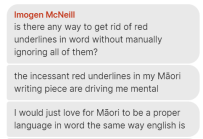
From time to time people reach out to me on Twitter with questions and earlier this week my mate Dave from Ripped Orange did precisely that:

Serendipitously, later that day my daughter reached out to me with some frustrations whilst writing a paper for her te reo Māori course at the University of Otago:

One thing led to another and after helping her solve the problem she had, I asked her if she would craft a quick guest blog post for me with how she did it and what the outcome was.

Guest Post from Imogen Te Rangimarie

Kia ora koutou,

As a university student studying some Te Reo Māori, I’ve learned a lot in the past year or so. Te Reo is a beautiful language and it’s particularly lovely to listen to. Less beautiful, however, is reading a Word doc in Te Reo that’s full of ugly red squiggles. Such was my complaint while completing a written assignment in Te Reo – though I’m very much still learning and making mistakes in the process, I was pretty certain that I hadn’t made as many as can be glimpsed below:

The Māori keyboard that enabled me to write in macrons did nothing to address the perceived spelling mistakes. I lamented this to Sam McNeill [editor’s note: Dad!], who sent me a link to a Microsoft support page: Add an editing or authoring language or set language preferences in Office (microsoft.com).

The instructions were as follows:

It turns out that Māori does, in fact, have proofing available, and so I followed the above instructions. It did take me a minute to find the Option tab, which is right down at the very bottom. From there, I was off. I selected Māori, and clicked on where it said Proofing available. It took a minute to download and install – my computer discovered other Office updates it wanted to do first – but the options screen ended up looking like this.

Observe how in the settings, it now says that Māori has proofing installed. It is possible to then set Māori as your default language if that’s what you mainly do your writing in, by clicking on the Māori row and then clicking Set as Preference. This requires a restart of Word but is then almost ready to go.

I say almost, because I was initially dismayed to discover that the 800-odd words of my assignment were still full of red underlines – clearly it didn’t automatically apply to previously-written text. To get around this without retyping the document, I cut and then pasted without keeping source formatting. Lo and behold, gone were the red lines for all but a few unusual names, as you can see below:

The next thing I discovered was that the benefits went beyond the page being much easier on the eyes – the proofreading actually worked. (That is, it worked as far as I could tell; it may be that there are more complex aspects of Māori that it struggles with). Observe the underline in the example sentence below:

Not only has Word correctly recognised that ‘nga’ is not the right spelling, but it even prompts a correction upon right-clicking, as below:

In my opinion, this is pretty fantastic! If we’re looking to normalise the use of Te Reo while out and about in the world, it’s incredibly useful to be able to write documents in Te Reo Māori without having to backspace and retype every particle i after it autocorrects to a capital I. I’m stoked that the process for installing Māori as a proofing language was straightforward, and Mahuru Māori seems an excellent time to have discovered it.