Categories
General

Opening Of The Green Library & Innovation Centre

Today I had the pleasure and honour of being invited back to St Andrew’s College where I have previously worked as the Director of ICT to be part of the opening of the Green Library & Innovation Centre. This was only an idea and dream when I left in 2016 and to see this fully realised through the leadership and vision of Wilj Dekkers, Head of Innovation and Information, was such a joy and privilege.

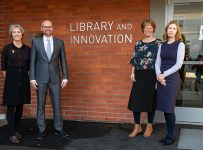
Wilj and Team
Mr Wilj Dekkers and his team at the opening of the Green Library & Innovation Centre

As the guests arrived to be seated they were welcomed by the College’s Kapa Haka group who sang a number of waiata (songs):

KapaHaka

The Rector, Christine Leighton, provided the opening address before introducing Wilj Dekkers, the Head of Innovation and Information for the new Green Centre with this whakatauki (Māori proverb):

He rangi tā matawhāiti
He rangi tā matawhānui

A person with narrow vision has a restricted horizon.
A person with wide vision has plentiful opportunities.

Wilj speaking
Wilj Dekkers speaking during the opening of the Green Centre

I was very impressed with Wilj as he described the genesis of the idea behind the Green Centre, the journey through to completion and as he acknowledged all of those who contributed to the project along the way.

At this point he described his vision for the Green Centre to be a place where students are challenged to grow, allowed to fail, and ultimately explore and find their passions. He shared a number of projects that were underway by students in the Centre (we got to walk around after the formalities and talk to these students) such as:


  • Students re-creating the damaged Christchurch Cathedral inside of Minecraft:Education Edution with a similar project scope used to re-imagine the Battersea Powerstation in the UK.
  • A student who was exploring a business project of creating educational apps, including one already created using Virtual Reality to help students in a special-needs school learn safe ways to cross the roads
  • Students using 3D printing and laser cutting to design wearable art
  • Students competing in Vex Robotics Competitions (one of these robots was used to cut the ceremonial ribbon, officially opening the new Green Centre – see below)
  • A student who had programmed a web application to receive payments and collate orders for junior students in the Preparatory School to safely and easily place lunch orders from the school cafeteria
  • A student who had designed and then built the St Andrew’s College Chapel entirely out of Lego blocks

The St Andrew’s College writer in residence Kerrin P Sharpe wrote a poem for the building entitled Kakariki Twins which means “Green” in Te Reo Māori:

Kakariki Twins
This sister whare matauranga
is a pataka of books.
The mistress of reading,
who grew her roof, her walls,
her foundations from the earth.

This brother whare auaha
meanders between land and sea
and carves solutions
from many floating ideas.

She braids her hair, with shingle
from the Rakaia River.
He braids his hair, with shingle
from the Rangitata River.

She’s the one who carries
clear water to farms
and coaxes wrybills,
terns, gulls, dotterels
back to their wetlands.

He’s the one who thinks
about the double helix
of water, the technology
of the natural bridge.

Like woven threads
they construct rafts together
and lower water levels.

Whare matauranga plants
saplings beside Strowan Stream
and dreams in green.

Whare auaha swims
inside the sky
and knows no limits.

These twins, green and innovative,
cradle the St Andrew’s hapii
beyond Moana-nui-a-kiwa.

Kerrin P. Sharpe
April 2018

Finally, the big reveal with a student created robot cutting the ceremonial ribbon:

2018-06-08 12.31.41
A student re-creating the Christchurch Cathedral in Minecraft:Education Edition (this was severely damaged in the 2011 Canterbury Earthquakes)

One of the coolest parts for me was seeing a Year 9 student called Ivy working on a Surface Studio showcasing her amazing artistic talent:

Ivy
Ivy, Year 9, at work on a Surface Studio – she starred in a Surface Pro video as a Year 6 student

As a Year 6 student she was a student of Mr Dekkers when he was still a full time classroom teacher and ended up appearing in a Surface Pro video:

It was special to see her progress since then and ‘complete the story’ in a way.

Overall this was a very special event to be invited to and I’m excited to see how the innovation continues through the Green Centre.

Categories
Windows 11

Microsoft HoloLens Delivers Wow Factor In Maths

HoloLens2This article first appeared in the Interface Magazine May 2018 edition and has been republished with the kind permission of the editors of Interface. You can see the rest of the great articles here.

Known for his digital innovation and creativity in teaching, the Microsoft HoloLens team knew Subash Chandar K was just the person to try out Virtual Reality with his maths class – and the results were amazing.

“Virtual Reality is something that’s interested me for a long time – and not just VR but Augmented Reality (AR) and Mixed Reality (MR), as well,” said Subash Chandar K, Curriculum Leader of Mathematics and Statistics at Ormiston Senior College in Auckland.

“I can see in 3D space. I’ve tried so many different ways to explain my perspective to students but with varying success – it’s quite challenging. Students struggle with concepts like volume and area. I tried creating 3D models with SketchUp, and turning them upside down and looking at them in different angles. They started to see but not as well as I wanted.”

Subash is a Microsoft Innovative Educator (as well as a ‘Sphero Hero’, one of only 18 in the world!). He describes being a MIE as “the biggest catalyst in transforming my perspective on teaching.”

“It’s opened me to what other educators in other countries are doing. I’m chipping in and contributing where I can. I think HoloLens was looking for maths teacher wanting to do something different and knew I was the guy willing to try tech.”

About HoloLens

HoloLens is a pair of Mixed Reality smartglasses developed and manufactured by Microsoft. It has see-through holographic lenses that use an advanced optical projection system to generate multi-dimensional full-colour holograms

microsoft.com/en-nz/hololens

HoloLens

Excited and engaged

He was provided with four HoloLens kits and some newly-developed apps to try – and asked for feedback.

“There were practical things like how students cope with something on their head and the VR space. But, essentially, it was exploring what could be done with HoloLens and maths.”

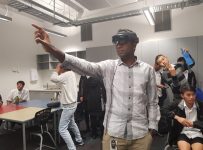
Subash wore one headset, while students wore the other three. The system let them see where he was looking, so they could literally follow his eye.

“We looked at 3D shapes and measurements. I could open a box into a net and explore how different sizes and how surface area can be calculated. It was mind blowing, and really got them excited and engaged.

Becoming the norm

What sort of future does Subash see for VR in education?

HoloLens3“I can see so many possibilities in maths and science, physics, biology, even drama – across all different subjects. I’d like to see VR developed from a makerspace angle – making it a stepping stone, where students can see how things pan out in virtual space before printing products, for example.

“The other day we were measuring things and I put 900 on the board. One student asked what the unit was – if I’d been able to show them the perspective in virtual space, they wouldn’t have needed to ask. Students often struggle to make planes in their heads – they can more easily see what it is from within the virtual environment.

“I see kids afraid to make mistakes on paper, but I feel they’re more confident working in a VR environment, happy to give it a go.

“VR is going to become the norm. But it’s one thing hearing about the technology, I encourage all teachers to experience it.”

Comment from one of Subash’s students:

“We are a generation that learns through examples and visualisation, not explanation and reading, and HoloLens is supportive of this. It helps us rediscover the touch of ingenuity we have lost through the boring, old methods and disconnected learning environments.

“HoloLens inspires critical thinking. It has tremendous potential because it gives us as students so much freedom to experiment, and the only limits are our creativity and imagination. This is not changing what we learn but simply how we learn it, and it may just be the solution to the problems of our education system.”

Categories
Windows 11

HoloLens – Seeing IS Believing

hololens-0-0I’m in Seattle this week for the Microsoft S4 Conference and am enjoying seeing the truly global perspective of Microsoft as a company. Virtually all of the sessions I’ve attended are covered by the NDA (Non Disclosure Agreement) I’ve signed as an employee so I can’t discuss anything from those unfortunately, but yesterday I did have some great luck.

I was provided a HoloLens unit for the night to have a good play with. If you’re not familiar with what HoloLens is then the official description is:

Microsoft HoloLens is the first self-contained, holographic computer, enabling you to engage with your digital content and interact with holograms in the world around you.

I’ve known about the HoloLens for a while now and, I have to admit, I had been a bit skeptical about videos like the above – surely these were “mocked up” demos of what could be possible, not what was actually already here with the current iterations of HoloLens.

I was dead wrong.

The last time I was truly blown away by a bit of tech I was hands on with was around February last year (2016) when I saw the HP Sprout in Melbourne. The HoloLens is staggeringly immersive – I definitely “lost” three or four hours playing on it last night with most of that on Fragments:

Fragment.PNG

You become the detective in a high-tech crime thriller. Experience compelling new possibilities for storytelling and gameplay.

Some thoughts on Fragments in no particular order (keep in mind I’m not a gamer at all, this did a lot to draw me in!):

  • You start by scanning/mapping the room(s) you’re in so that the game understands your environment – you are not restricted to a pre-build world to play in.
  • The audio – it’s amazing surround sound from the HoloLens – you just get used to hearing someone talking “over your shoulder” and turning around and seeing the holographic representations of people; it’s entirely believable and lifelike audio.
  • The game play – it responds to your environment i.e. characters sit down on your furniture, they walk through your doors. It’s really difficult to describe just how amazing that is and the value it adds to game play until you’ve actually experienced it for yourself.
  • You very quickly adapt to the tools at your disposable in this mixed-reality environment:
    • You forget within 5 minutes that you’re wearing a headset (honestly, you no longer notice it).
    • You start to rely on virtual tools e.g. you have your “crime lab” and “maps” pinned to one of your walls and you just get used to returning to that time and again during the investigation.
    • Voice commands – leveraging Cortana you just speak naturally during the game e.g. “examine this evidence” or “launch scan” “close” – you can use the hand gestures to do all of this as well, but you often find it faster using voice. Further to this, you quickly increase your speed of interacting – you pick up, examine, dispose of evidence faster and faster as you get used to it.
  • You’re very active
    • You’re literally walking around your room, scanning for evidence and exploring what is being holographically represented on the floors, walls, roof, tables etc
    • As you move around the room the characters move too – they watch you, their eyes follow your movements etc.
    • When the action freezes as part of the game play, you can “walk around” or “circle” the scenes/characters to see the full 3D elements of the game play.
  • You’ll lose track of time! I only stopped playing because the battery was going critically flat!

If I sound excited, it’s because I am. I’ve seen Occulus Rift before and they’re amazing too however you are always tethered to a PC generating the content. To be able to wander around within a mixed reality environment with no cables was liberating.

I could go on, but you probably get the idea. Another app I played with was the HoloLens HoloTour:

This was also very immersive and educational. I’ve never been to the Colosseum in Rome before but with this, being able to walk around inside it, it felt like the next best thing. Whilst I am sure it is very expensive to develop this kind of content, you can definitely see how this has a place in education. Speaking of education, the HoloLens Insight Heart app is a good medical training application that shows a proof of concept about how students could potentially be trained. Again, the voice commands were super easy and responsive e.g. “make bigger/smaller” or “rotate” or “pause” – the app responded immediately to these commands:

The guy that loaned me the HoloLens said he now uses it as his primary device for completing “work” at home – from email to Excel spreadsheets to browsing the web, he just sits on his couch with a bluetooth paired keyboard/mouse and gets to work. He will pin a browser to one wall, his email to another and flip between them by moving his head. Because HoloLens will remember the layout of your house/room and always keep your pinned apps in the same place you can do things like pin a weather app to the back of your front door so you always know the weather forecast as you’re exiting the house.

Furthermore, the natural interaction between the real vs holographic world is evident and natural. For example, if you have an open app as you move it around the room to “pin” it somewhere you may decide you want to put in on table. As you move your hands to lower the app onto the table it will meet slight “resistance” as HoloLens recognises the real, physical table and provides resistance as a prompt so you can set the app down on the surface of the table. You can override this of course by pushing a bit harder, but this highlights the fact that HoloLens has a true awareness of the physical reality around you and applies that to everything you’re doing virtually.

I think this is a key point: whilst the truly immersive 3D apps are still largely in development, you can run any Win32 app via HoloLens still because it is a fully functioning Win10 device. This means it is both useful immediately and will only increase in usefulness as more apps are developed.

Here’s an example of a developer building such an app for a proof of concept:

The take home message is this – if you get a chance to play with a HoloLens jump at it! It’s an experience that you’re not likely to replicate easily elsewhere and it is truly hinting at the innovation and future that is coming.